In his village, on one of the hills of Mount Lebanon where he spent most of his summer time, the sound of cicadas is omnipresent. They can be found on every pine tree of the forest that surrounds his grandparents house. For people who grew up in the city, that sound can be unbearable. For him, it’s the soothing sound that, whenever he laid down on the porch swing, conspired with the rocking motion to take him far away into the land of nod.
Cicadas of Mount Lebanon spend several winters underground in the form of larvae. Come summer time, those who are ready come out to the surface, shed their larvae skin to free their wings, and take off for a summer where their voice fills the atmosphere.
Like a cicada, the young boy feels that his time has come to shed his old skin and reveal his new wings.
His old belief system had shattered and it is no longer suitable for the new journey that is about to begin. Around him, no one seemed to have stumbled on the same revelations that shook his world. No one except one classmate.
There was almost nothing in common between him and Patrick. Patrick is an extrovert, has an unusual hair style and is an assumed intellectual rebel. His favorite pastime is to challenge the teachers with questions that put them at the edge of where they are willing to adventure. His favorite “victim” was the catechism teacher.
Before summer 1998, the young boy would feel a deep unease whenever Patrick unleashed one of his brazen tirades on the Brother who was burning through every ounce of faith he had to cling to his certainties with quiet grace. After 1998, Patrick’s glimmers of wisdom began to glow with truth.
One day, during the mid-term catechism exam, Patrick raised a challenge: complete the exam as fast as possible. About a minute in, the young boy had already finished skimming through the text. He glanced at Patrick who got up from his seat ready to submit his copy. He already had a good guess what Patrick’s answers were, and 30 seconds later, he was ready to submit his.
Once outside, the two classmates were laughing victoriously as they realize they submitted the exact same answers:
Q: What is this text about? A: It’s about the good shepherd and the good shepherd takes good care of his sheep1.
Q: What role did Jesus play among his disciples? A: Jesus was the good shepherd and the good shepherd takes good care of his sheep
Q: What is the role of [blank] A: [blank] is the good shepherd, and the good shepherd…
…
While they were waiting for the rest of the class to finish, the boy was wondering: how come Patrick already knew?
Patrick speaks with ease, radiating confidence. He was not a cicada, he was born with wings. The quiet boy, who until now looked at Patrick with an envious eye as one gazes at an idol, now finds himself standing on the same pedestal alongside his peer.
If Patrick did it, he can as well. And if the new truth has become obvious to him, now that he has risen above the fog, it shouldn’t be so hard to speak it out loud.
Priesthood aspirations are long gone by now, replaced by an aspiration for Science. And Sainthood has acquired a new meaning. Kindness, truthfulness and the lust for knowledge are not new values to the young boy; they are what the Lassalian Brothers taught him year after year. What changed is their source. They no longer draw their essence from doctrine, but from what is shared across cultures, ethnicities, and religions: the human being underneath.
To tell or not to tell — that was the question.
A question that did not take long to be answered. Silence became a lie. Pretending to make the sign of the cross during mass grew increasingly unbearable. And the feeling of carrying a truth that begged to be shared came to overweigh the fear of being ridiculed.
Summer break returned, and the cicadas are once again everywhere.
On a Friday morning, while watching a movie with his younger brother, the moment felt right.
Every first flight requires a leap of faith. The wings have never been tested, and the view is vertiginous. Reason urges the jump; instinct tries to hold every muscle in place.
Eventually, the words escaped, followed by a moment of silence, as he stood there, watching the astonishment on his brother’s face.
It was a common practice in catechism classes to paraphrase passages from the bible instead of quoting verbatim, presenting the youngsters with an easier version to grasp, often with a little polishing along the way. The original catch phrase from John 10:1-18 reads: 11I am the good shepherd; the good shepherd lays down His life for the sheep.↩︎
“Let me tell you, children, about a young boy who loved God more than anything else — his name was Dominic Savio… One day, Dominic said to his mentor Don Bosco: ‘Father, I wish to become a saint.’ Don Bosco asked: ‘And how will you do that, my son?’ Dominic smiled and replied: ‘By being cheerful, studying hard, and loving God with all my heart.’ […] Dominic Savio never grew old, but he grew holy — proving that greatness begins in small acts of goodness. For in the Lasallian spirit, holiness is not found in grand gestures, but in doing ordinary things with extraordinary love.”
Brother Habib, interrupting a random class — Collège Notre Dames des Frères Furn-el-Chebbak, East Beirut, 1991 (Paraphrasing).
Lebanon, East Beirut, 1982, a baby boy is born in the middle of a raging civil war. That year was a turning point in the Lebanese civil war which transformed, after the Israeli invasion of Beirut, the defeat of the PLO1 and the assassination of president Bachir Gemayel, from a Palestinian-centered war into a confessional and ethnic cleansing war between Lebanese factions asserting their dominance in their respective territories.
The little boy woke up to a world where the sound of machine guns and cannons was a daily normality. Raised in a catholic family, he went to a catholic school founded in the late 1800s by French missionaries: The Lassalian Brothers (Frères des Écoles Chrétiennes) brought to Lebanon by Elias Howayek, who would later become Patriarch of the Catholic church in the Middle East.
The Brothers, inspiring piety, kindness, and confidence, are often charismatic individuals and good story tellers. Their favorite hobby is to tell the stories of the Saints. The little boy was thrilled whenever an arithmetic class is randomly interrupted by one of the men in the black cassock and the split white collar, for a brief getaway into the lives of Dominic Savio and his educator Don Bosco, Saint Vincent de Paul, Saint Thérèse of Lisieux, the apparitions of the Virgin Mary in Lourdes or Fatima, and many more gems from their rich repertoire of spiritual saintly tales…
Jean Baptiste de La Salle Founder of the Lassallian Brothers
Needless to say, the young boy wanted to become a saint. And apart from the young Dominic Savio who passed prematurely, the other saints were predominantly priests. And what better way to get closer to God than by becoming a priest?
The future of the young boy is clear in his head: become a priest, live a life of studying hard and loving his fellow humans as much as loving God, and the path to sainthood is paved. Little did he know that the world had other plans, lurking just below the horizon.
As far as studying hard, it was all relative. In many Lebanese families, parents cared less about their child’s grade than about their rank in the class. In a class of thirty or more, only one child could truly make their parents proud, while the rest were left feeling that their best was never enough. The young boy’s parents were not of that kind. And with his quiet and reserved nature, avoiding the spots was a must. It worked best for him to study hard enough to dodge being publicly shamed, but not hard enough to be publicly praised.
Until one day, in June 1992, the 10 years old boy was to face a surprise. During the end of the year ceremony in which the Brothers distributed the grades and the special honors, he heard his name in the part of the ceremony that he expected the least: a special honor for ranking first in arithmetic was awarded to him. The boy is filled with anxiety; he knows that he must walk to the pedestal in front of the whole class, shake the Brother’s hand and accept his words of praise. Should he show pride at the risk of sounding pretentious? Or should he show humility at the risk of diminishing the Brother’s commendation?
The moment passes and relief comes when the attention of the class shifts to the next special honor with another kid’s name being called. Back in his seat, alone with his prize, he wonders how this came to be. He never studied too hard for arithmetic; at least not more than he studied for the other subjects. It occurred to him at that moment, that he might have a natural instinct for the subject. When the ceremony ended, and the kids were free to move around, he was surprised to receive a few pats on his shoulder from fellow classmates. He had to admit to himself that it was pride he was feeling at that moment. Pride mixed with astonishment: a discovery that marks a new era of the boy’s life.
That incident repeated itself in the years to come. Arithmetic was later called mathematics, and science was split into Physics, Chemistry and Biology. The prizes at the end of the year multiplied, now physics was on the menu too. The boy becomes a reference among his classmates in matters of Sciences. Because he’s less intimidating than the teachers, they preferred to come to him for their delicate questions. The teachers were also noticing him, and showing him less authority, more friendship and more trust.
A new passion for Science was thus born, and with time, it only grew stronger. But what about the Priesthood? And what about Sainthood? Perhaps the path to holiness did not have to pass through the Priesthood after all? He yearned for another way to express his love for God. Then it occurred to him: if God had granted him the gift of Science, perhaps Science was meant to help him find his way to the Divine?
At the age of 16, he embarks on a quest: deeply study the sciences and deeply study the scriptures until he finds the way to “reconcile” the two disciplines. Indeed, it had already occurred to him that few points of discrepancy arise when pondering on the two subjects independently. But those discrepancies must be superficial and only obvious for those who don’t dig deep enough. So deep enough he must dig.
Summer 1998, the school year is over, and the next year doesn’t start until three months later. What a better use of this time other than reading the scriptures. The challenge was to read the Bible, Old and New testaments, from cover to cover.
Michelangelo, The Creation of Adam (1512), Sistine Chapel.
Genesis Chapter 1:the first disenchantment.
The Firmament. That dome in the sky that holds the Sun, the Moon and the stars and separates earthly waters from Heavenly waters from which rain falls. There was an account of cosmology and the cycle of water very different from the tales of modern Science books.
Genesis Chapter 2:a second disillusion.
The story of Adam and Eve clashes not only with the accounts of Darwinian Evolution, but also with the accounts of Chapter 1. If in the first account God created men and women equally “in His image and likeness”; now it seems that Eve is created as an afterthought after God realized Adam is lonely and after the creation of plants and animals as a first attempt to satisfy Adam’s needs.
The deeper he dug, the more difficult it was to wrap his head around the material he was reading. Questions started to build: throughout years of catechism, he never heard the tales he was discovering being told in those words and in that order. Perhaps to reconcile Science and Religion, Scripture needed to be read not as a literal account of events, but as a collection of symbolic and poetic tales that ultimately form the moral story of humanity’s effort to live justly and harmoniously with one another.
But wouldn’t that make God himself a symbolic and poetic metaphor of some ideal that Man aspires to attain? The teenager puts this thought aside and decides to read the rest of the book, searching for ethics and morality instead of a literal truth. Little did he know what lay ahead!
Michelangelo, The Creation of the Sun, Moon and Plants (1511), Sistine Chapel.
If the story of Abraham being commanded to sacrifice his son Isaac can be dismissed on the account that ultimately God rejected the act, other accounts didn’t end that gracefully. The story of the Flood, the destruction of Sodom and Gomorrah, the slaughter of the Canaanites, the lament of Job, the plagues of Egypt, and the list goes on… Not to mention the laws permitting slavery and the treatment of women as property and prizes of war. God seems to be portrayed as a powerful and angry being with temperament often contradicting His supposedly loving nature.
Maybe the Old Testament is ultimately a tale of humanity misunderstanding God. The New Testament must then bring to the light the real ethics that God wants to bestow on mankind.
And indeed, the New Testament puts forward a major moral upgrade with a message of love, compassion, forgiveness, and humility. But the book is not devoid of passages of self contradictions and lower moral stands. Slavery was not deeply challenged, and in many parables, the devotion of slaves to their earthly masters is seen as a virtue akin the devotion of man to God2. Women are given important roles and portrayed as source of wisdom in some passages, yet in other passages they have a lower role and are instructed not to speak in the temple or against their husbands will3.
It seemed to the young boy that if the New Testament brought an abundance of moral beauty, it still needed to be read with discernment, and its contradictions to be filtered through the conscience of the reader.
The civil war had been over for several years by then. But the trauma of those who lived through it as adults was still alive.
A woman from his neighborhood could not stand near windows, on rooftops, or on balconies. She would freeze in place at the smallest burst of a loud noise: her hands would start to shake as she drops whatever she’s holding. During the war, she had lost her fiancé, victim to a sniper from his own camp, mistakenly killing him as he was bringing lunch to his company. Needless to say, the war never ended for her.
She had a confidant, as many did during that time; a priest she would go to whenever the burdens of life feel too heavy to bear alone. One day, she collapsed at work and was admitted to the hospital in an atmosphere of secrecy around what happened to her. The young boy would later find out that it was due to complications from a hidden pregnancy she had tried to end on her own. It was clear that if the fetus bore her husband’s genes, it would have been more than welcome in her devout christian family.
Her suffering wasn’t a failure of her character, nor a scandal of one priest’s weakness, and certainly not unique. Her pain was common, not in the details of the events, as every story is different. But there was a repeating pattern emerging from trauma, chronic suffering, and religious and social pressure. Devout people practicing their religion faithfully. Faithfully in what concerns the signs, the gestures, the spoken words, the order in which words are spoken, the timing… the Divine choreography. Yet when it came to their actions and life choices — when fighting a war under the banner of religion — it seemed that everyone, the lukewarm, the devout, and the priest, all picked and chose from the moral table before them, whatever suited their world view, their history, their interests, and their circumstances.
The central question became: to what North the moral compass points? If it points to the scriptures — ambiguities set aside — then why do the compasses held by different people fail to align? Could it be that each compass turns inward, toward its holder, pointing in whatever direction life had steered them? Could it be that we invented the whole thing?
At that moment, it felt that the world had tilted, almost upside down, as if to straighten itself after being held for too long in an awkward bend. In a strange mixture of pain and relief, a deep sense of revelation, and the feeling that a new journey is about to begin, the passage from Genesis 1:26-27 resonated in the teenager’s head, but this time, the text read:
26 Then Man said, “Let us make god in Our image, after Our likeness; and let him have dominion over Our fears and Our hopes, over the heavens of Our imagination, and over all things unseen upon the earth.
27 So Man created god in His own image; in the image of Man He created him; of Love and Fear He created him.
Parable of the Wise and Faithful Servant (Matthew 24:45–51; Luke 12:42–48); Parable of the Talents (Matthew 25:14–30); Parable of the Master and Servant (Luke 17:7–10); then Romans 6:16–22; 1 Corinthians 7:22; Ephesians 6:5–8; Colossians 3:22–24; Titus 2:9–10; 1 Peter 2:18–21. ↩︎
Parable of the Ten Virgins (Matthew 25:1–13); Parable of the Persistent Widow (Luke 18:1–8); then Corinthians 14:34–35; Ephesians 5:22–24; Colossians 3:18; 1 Timothy 2:11–15; 1 Peter 3:1–6. ↩︎
Artwork in this article are created by the author using AI assisted as well as classic editing tools.
He steps on a penny. That morning, lurking just below the horizon, the sun is ready to shine its first beams of light. A cool breeze, saturated with the humidity of the morning mist, whispers in his ears. Barely intelligible. He couldn’t quite decipher what it’s trying to say, or whether it’s trying to speak at all. Intrigued, he looks down to notice the penny, starting to shine as the first morning beams flare its surface. He picks it up. Once in his palm, closer to his eyes, the carvings on the penny seemed unfamiliar. The more he looked at it, the stranger it appeared to his eyes. The goddess of odds stood before him with her happy side majestically facing him. She smiled and whispered: the prayers you made the night before have been answered. Later that week, the rare penny was auctioned for a small fortune.
He steps on a penny. Intrigued, he looks down to notice the penny. It’s just a penny. He moves on.
Countless pennies get stepped on countless times day after day. And the rare pennies, sitting there defying the passage of time, get stepped on countless times before someone picks them up. When they finally do, the aura of mystery is never away. The presence of the goddess of odds feels as real as the penny being picked up. Her whispers carried by the morning breeze are heard loud and clear. She goes by many names. Some call it destiny, others call it divine, and many use words that start with para or meta or something along those lines… And then there are those, like myself, who just call it math.
There is indeed a formula. A simple one that doesn’t need a major in science to grasp:
or in a slightly different form:
The first form is known as the definition of “probability”1. The second form is useful when making a tour at an auction gallery and being confronted with but a few of the most amazing stories, the type of which collectors are fond of.
is easy to measure. Those are the stories we tell. The ones we listen to with eyes wide open and jaws struggling to fight with gravity. is hard to compute: it requires a complicated model of reality that even the most evolved AI on the planet doesn’t have enough neurons to describe2. But intuitively, we know when it’s small, when it’s impalpably tiny, and often we’d be right. The one that seems to be hard to grasp, that defies common sense and feeds into mystery and wonderment, is .
is what we don’t measure. The stories we don’t tell, those that remain unnoticed even by the protagonists themselves. Stories too insignificant to live and certainly too dull to listen to. We tend to forget they exist or at least fail to imagine their sheer numbers. Our ancestors, concerned with the number of prey they were able to catch and the number of predators they managed to escape, did not evolve brains to deal with huge numbers. After all, who needed to count the stars in the sky or the hairs on their head?
The truth of the matter is, that the rare penny was sitting there for centuries getting stepped on while waiting to be picked up. Sooner or later, somebody would have. The whispers turned out to be but the sound of the breeze caressing the leaves. And the goddess of odds, to whom we attribute more than what she actually does, was merely counting the steps and taking notes in her book of time, mainly for her own curiosity. Never she cared to intervene. Maybe by fear of biasing her own data. See, she’s as wholesome as a goddess can be.
And we, oblivious to the many untold stories, fill in the blanks of our nescience with stories fabricated by our minds. Another great skill of our imaginative brain: filling in the blanks. For some reason, those of our ancestors who took the time to investigate when they had incomplete data, got eaten by what turned out to be a predator.
Mysteries, miracles, curiosities, wonders, omens, prophecies, paradoxes, coincidences, and the list goes on. Count the number of minutes that exist in the many lives there are, contemplate the many ways the next minutes could unfold based on the events of the minutes that came before, and the unlikely becomes foreseen3.
We seek mysteries in peculiar events that actually happen every day. Our brains crave wonderment and awe; and yet, recognizing that the unusual and the mundane are made from the same fabric of chance, shall make the story no less magical, only more real. Suffice to remember the greatest achievement of the goddess of odds: out of the endless possibilities of gene arrangements that never saw the light, it is us who are here, alive in this moment, wondering about the world — not simply as a coincidence to dismiss, but also as the most awe inspiring accident of all.
The connoisseur here might object slightly and demand more rigor in the usage of the terms. I’m aware of that. I’m also aware that for what concerns the usefulness in this context, this is an accurate enough definition. ↩︎
Those who studied probabilities at high school may remember how nontrivial it was to compute probabilities for problems involving a handful of colorful balls. Now imagine extrapolating this to a problem involving billions of people doing random things at random places all day long all over the planet, with the added complexity that what any one person does at any given time, may or may not impact what the others can or cannot do from that time onward. ↩︎
The connoisseur requesting mathematical rigor might again protest that multiplying the very tiny with the very large (0 × ∞) yields an undetermined result. Here we’re talking about phenomena that occur frequently enough to get noticed, but not enough for our brains to get used to. So for the technical pendant, we’re interested here in the cases where (0 × ∞) yields a finite result. ↩︎
I don’t remember the exact day when I actually understood what the term “Evolution” means in the Darwinian sense. But I remember that it was a day.
Unlike the other pieces that constitute the largely incomplete knowledge baggage that I carry, understanding Evolution was not a graduate process. It was literally a click; a sudden revelation before which everything about this theory was ridiculous, dark and even sinister.
And then one day: Eureka! If there is a handful of men that could be described as the greatest scientist minds of all times, Charles Darwin is definitely one of them.
As a child growing in a non-secular society where superstition still rules over people’s intellect, Charles Darwin was introduced to me in an atmosphere of rather bad publicity: there was the deluded man who believed that once a monkey gave birth to a human baby from whom we all descend. Put in these terms, his ideas felt of the type that could only be preached by a crazy and wicked ignoramus.
Until I was old enough to read about them myself.
Then I understood the three simple elements that when put together, can elegantly solve the greatest mystery of all times; Life:
Growth with Reproduction and Inheritance: the process by which a certain form of life creates copies of itself to ensure its own growth and continuity to at least one more generation.
Variability: the imperfections in reproduction through which inaccurate copies of a given form of life are introduced into the next generation (mutations), thus creating diversity.
Struggle for Life and Natural selection: the process through which those forms of life that are better equipped to succeed at reproduction are the ones that get preserved through generations at the expense of those that are the least.
How brilliant!
A very simple principle yet powerful enough to explain that from star dust consciousness can arise!1
The many elaborate and diverse ways of adaptation that can be witnessed in Fauna and Flora, were for so long mistaken for being carefully and purposely designed by a supreme being. And for a good reason; almost every feature of every living creature is useful in some way to its bearer. As amazing and mysterious as it may be to think of a higher order that pulls the knobs and puts the clockwork into action, it is by far more inspiring to ponder the fact that the higher order is but a set of simple laws of Nature.
And not only Life is explained, but also Death. No form of life could have ever been made so perfect from the first attempt: that would indeed be very unlikely and highly improbable. Death has to occur because it is Nature’s way of trying again, in order to come up with the best designs through a continuing cycle of trials and errors. The most brilliant engineers on the planet can certainly appreciate the power of this technique!
To allude that the sheer complexity of life is a proof of an unnatural aspect in the process of creation is to seriously underestimate Nature.
And not only biological life is concerned. Think of life as an abstract concept, a dynamic system that can exist in different levels of complexity; as long as its “design” is constantly subjected to some form of a “goodness” test, natural selection is bound to guide its evolution. Once I was able to grasp this, I could start to imagine the wide range of disciplines to which the Darwinian principles may apply.
Our human language, our sense of beauty, our political, economic and social systems, our culture in general and even our religions, if examined closely, all exhibit aspects that can most rationally be explained by Darwinian-like evolution.
To cite but one example, social studies have shown that local groups of people tend to come up with their own unwritten set of rules in order to organize common interests among each other, often ignoring the state laws2. This can be explained when we realize that under certain conditions the interest of the whole group is favored by a ‘tit-for-tat’ strategy of cooperation among its members. The question remains how this has become intuitive to humans? Some of it may be encoded in our DNA and constitute our natural inclination to altruism, but most of it can be understood through a tradition of trials and errors or the so called “lessons from those who came before us”. People learn, through their interactions with each other, what works and what doesn’t, and those ideas that work are passed along and become part of the traditions.
It is awe inspiring to contemplate how such a principle is so simply formulated and yet so powerful in its consequences and so general in its capacity to explain a wide range of phenomena spanning across many disciplines.
As Charles Darwin said in the closing statements of his famous book that started it all:
“It is interesting to contemplate an entangled bank, clothed with many plants of many kinds, birds singing on the bushes, with various insects flitting about, and with worms crawling through the damp earth, and to reflect that these elaborately constructed forms, so different from each other, and dependent on each other in so complex a manner, have all been produced by laws acting around us. […] Thus from the war of nature, from famine and death, the most exalted object we are capable of conceiving, namely, the production of higher animals, directly follows. There is grandeur in this view of life, […], from so simple a beginning endless forms most beautiful and most wonderful have been, and are being, evolved”. Charles Darwin — On the Origin of Species, 1859
Research suggests that in early Earth, Life would have spawned from autocatalytic networks of increasingly complex chemical reactions. In a nutshell, these are chemical reactions that produce their own catalysts and therefore are able to self-regenerate. We can think of these networks as the ancestor of Life, and the process that led to DNA-based life from rudimentary self-sustained chemistry to resemble the process of evolution by natural selection. ↩︎
See for example: Robert C. Ellickson — Order Without Law: How Neighbors Settle Disputes, 1991↩︎
“After dinner, the weather being warm, we went into the garden, & drank thea under the shade of some apple trees […] he told me, he was just in the same situation, as when formerly, the notion of gravitation came into his mind. Why should that apple always descend perpendicularly to the ground, thought he to himself: occasion’d by the fall of an apple, as he sat in a contemplative mood.” William Stukeley, Memoirs of Sir Isaac Newton’s Life (1752), Royal Society MS/142
The story goes, as far as popular culture is concerned, that Sir Isaac Newton got his inspiration for his theory of gravity when an apple fell on his head, as he was gazing at nature under an apple tree.
But there is a catch: in the accounts reported by Newton himself and relayed by some of his acquaintances, the apple fell, but not on his head . A detail you might say, and you’d be right! But that’s not the catch!
Although it is likely that an anecdote involving an apple did happen, as often told by the protagonist himself, it is extremely unlikely that an “Eureka” moment is enough for anyone, not even for the Greatest Scientific Mind of all times, to come up with the fundamentals of science.
Maybe he found the apple example simple and appealing, maybe the anecdote amusing to tell. But one thing is true: Science is never made of single observations of anything. Newton must have spent hours, days, even years, observing falling objects over and over again. Taking precise measurements. Making calculations. Inventing a whole new field of mathematics.
Now here’s another detail that won’t cross many people’s minds: a falling object falls once. And quick. And then you have to pick it up.
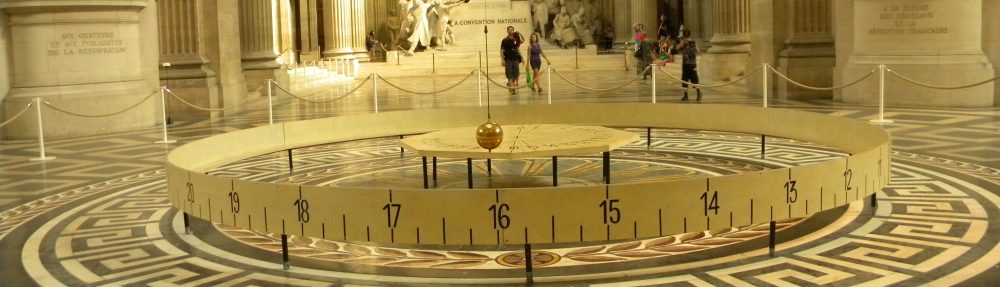
But, attach it to a string, and as it starts falling, the string pulls on it, causing it to swing from one side over to the other, slowing its movement down, until it stops, and then starts falling again in the opposite direction, and the cycle repeats over and over. How convenient. Newton must have spent hours experimenting with such a contraption. The pendulum: first studied by another great mind of science, Galileo Galilei1, was indeed instrumental in testing and validating the principles laid down in Philosophiæ Naturalis Principia Mathematica.
Now, at this point, you might be wondering: where am I going with this story? Why am I even interested in the pendulum — much less making it the title of this blog? Maybe because it symbolizes the instrument that started it all? The how and why Science, as we know it today began?
Maybe!
But both Galilei and Newton also looked and gazed at the starry night, the planets, and the moon. They knew perfectly well the motion of the errant stars. And as it turns out, the shapes drawn by these wanderers are sufficient inputs to fully formulate the sought after principles. In fact, they must have played an even more significant role for Newton than the relatively imprecise pendulum2.
So why not choose as a first cover photo a starry night under the arguably catchier title “Corpora Caelestia”?
The reason is rather simple: I can hold a pendulum in my hand.
I can touch it, feel it, and easily make my own out of readily household objects. I can use the one I make to take my own measurements, do my own calculations and see Science unfolds with my own eyes. It not only symbolizes how modern Science started for humanity, but also how Science can start for anyone curious to learn about the workings of the Universe.
And there is much more to this simple contraption. I will finish this article with this fact that has always blown my mind, and continues to fascinate me every time I think about it:
The motion of the simple pendulum is described by what scientists call “harmonic oscillations”, a smooth repeating motion. As it turns out, without entering into the mathematical details, the motion of any object, whether oscillating, moving in a circle, or tracing the outline of Mona Lisa, can be reproduced by the combined motion of several (or maybe infinite) individual harmonic oscillators, each vibrating at its own frequency and amplitude3.
The animation below4 illustrates how two harmonic oscillators can work together to outline a circle (left). Tweak the amplitudes, and you get an ellipse (middle), add a third one and you already get a much more complex shape (right).
The fascinating part, is that this geometric curiosity generalizes beyond the tracing of a dot on a screen: indeed, the motion of the harmonic oscillator is the mathematical building block that also describes sound (origin of the name “harmonic”), light, the flow of temperature in a conducting rod, and much more. Even the fundamental particles that constitute the stuff we and all animate or inanimate beings are made of. We are but a collection of vibrating stuff, which at the fundamental level, at the infinitely small, vibrate to the same dance as the rocking of a simple pendulum.
And yet, somehow, stemming from simplicity arises complexity: a consciousness with the ability to self-reflect and to ponder on its own functioning, that of the Universe which made it, and occasionally on a simple pendulum.
Galilei is credited with establishing several properties of the pendulum, among which: periodicity, the property that the time of an oscillation (period) stays the same in time; isochronism, the property that the period does not depend on the amplitude of oscillations; and the property that the period depends on the length and not on the weight of the bob. ↩︎
Arguably, the major contribution of the simple pendulum in Newton’s comprehension of gravity, was to demonstrate, that the gravity we feel at Earth’s surface, which pulls the apple downwards towards the center of the Earth, extends far enough to be the same force pulling on the Moon and keeping it in orbit. ↩︎
Frequency counts the number of oscillations per unit of time, and amplitude describes how far the oscillation extends. There is a third parameter I didn’t mention called the phase, which describes the initial state of the oscillator. It’s not very relevant when dealing with a single oscillator, but it plays a significant role when combining several oscillators as it describes their relative “synchronization”. ↩︎
Much better animations and deeper explanations of the mathematical origins of this fact are made by 3Blue1Brown in his series about Fourier Transforms. ↩︎
When I created this blog, an automatically generated post, intended to explain how to edit and make posts, was on my home page under the title “Hello world!“. Of course, the contents themselves were of little interest, however I thought that the title was exactly what I wanted to say in my very first post: so I kept it!
Hello world!
It’s an exclamation of joy and wonderment of being born into a new world full of secrets yet to be unveiled. It’s a way to announce to the world that a new born is here. And to the new born, it’s the first step in a long journey of exploration.
Since I am here and I want to say hello, I will break my own rule of not talking about myself and talk a little about myself. Namely about how I became a scientist and what does the word scientist mean to me.
It all started before I can even remember. My mother often tells the story that since my speaking skills reached a point where I could formulate complete sentences, I started asking about stuff like where does the Sun go at night and why does it rain in spring and not only in winter. My mother could very well be bragging about her lovely and fantastic first born, as all mothers do, but I do have many vague and some vivid memories of such episodes. Maybe my most vivid such memory is one of my father holding a tennis ball (representing planet Earth) and rotating it around itself and around a light bulb (representing the Sun) and showing me the movement of the shadow on the dark side of the ball with respect to the drawing of a small boy (representing me) he had depicted somewhere on the northern hemisphere.
I would like to believe – and there seems to be scientific studies favoring this – that all children ask these questions at some point in their early childhood. We are all born scientists and later crushed by society. Many parents may feel lazy or not educated enough to answer, instead, they find it easier to tell their children to go and play with the other kids. Children slowly and steadily let go of their wonderment. Later at school, teachers – who are overly worried about success rate – will provide them with algorithms to solve problems mechanically, preventing them from using the innovation skills that would otherwise allow them to solve new problems of types never encountered before.
Luckily for me, my early childhood was different. I was given explanations whenever I needed to, so somehow I came to always expect an explanation whenever presented with a claim. I remember my kindergarten teacher telling us once that God created everything, and I remember being furious in my mind because I knew that my uncle worked in a company that repairs televisions and I knew that televisions were made by humans in a television factory. God could not have crated televisions: I knew that my teacher was up to something!
For me, being a scientist is not to work in a science lab. Being a scientist is being curious, imaginative and critical about the world. We are all born with those qualities but tend to loose them whenever we don’t use them enough. So the best gift parents can give to their children is to teach them how to think and learn for themselves.
So here I am, embarking on this new journey, hoping to meet new people, to learn about their ideas and to share my ideas with them. Because I have always wondered what people think when they think about the same issues as I do!


 is easy to measure. Those are the stories we tell. The ones we listen to with eyes wide open and jaws struggling to fight with gravity.
  is hard to compute: it requires a complicated model of reality that even the most evolved AI on the planet doesn’t have enough neurons to describe
 .
.


 3Blue1Brown